
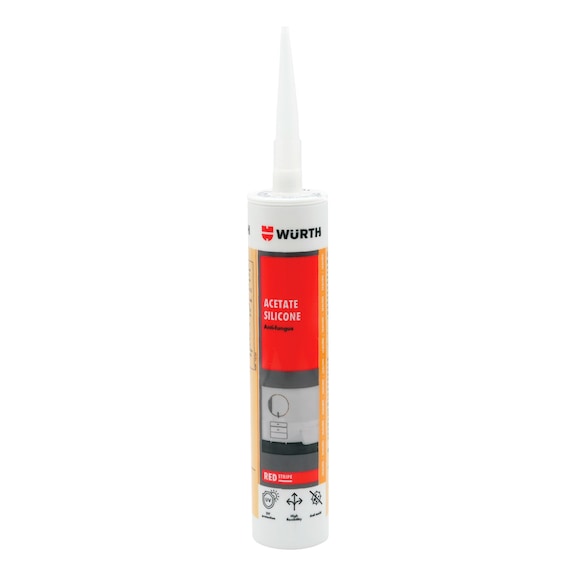
Acetate silicone sanitary purpose
For detailed information, other images and documents, please select individual articles from the following table.

Acetate silicone sanitary purpose
Acid silicone sealant is a single-component, acid-cured silicone sealant that can meet the mildew-proof requirements of level 0. It is suitable for glass sealing and industrial use. Acidic glass sealant
reacts with water vapor in the air at room temperature to form a silicone elastomer with long-term flexibility. It is easy to construct, has good durability, and is suitable for a variety of mildew-proof sealing scenarios.

Exclusively for trade customers
Register now and access more than 6,000 products
Variants
Exclusively for trade customers
Register now and access more than 6,000 products
• Grade 0 mildew resistance
• Long-lasting and efficient sealing
• Moderate viscosity, easy to apply
• Excellent flexibility
• Excellent resistance to high and low temperatures
• Long-lasting and efficient sealing
• Moderate viscosity, easy to apply
• Excellent flexibility
• Excellent resistance to high and low temperatures
NoticeAcidic silicone sealant releases acetic acid when curing. Acidic silicone sealant should not come into contact with metals such as lead, copper, brass, and zinc, otherwise it may corrode the metal.
Acidic silicone sealant may turn yellow when in contact with some organic rubbers, such as EPDM.
Acidic silicone sealant may turn yellow when in contact with some organic rubbers, such as EPDM.
Application area•Waterproof sealing in wet areas such as showers, wash basins, kitchen countertops, etc.
• Glass and door and window construction sealing
• Sealing the joints between glass and frames (display cabinets, display racks)
• Glass and door and window construction sealing
• Sealing the joints between glass and frames (display cabinets, display racks)
InstructionsThe substrate surface in contact with the sealant must be clean, dry, and free of any loose objects,
dust, dirt, rust, oil or other contaminants. Non-porous substrates should be cleaned first with a clean,
lint-free cotton cloth. Before the solvent completely evaporates, immediately wipe off the solvent with another piece of the same cotton cloth.
dust, dirt, rust, oil or other contaminants. Non-porous substrates should be cleaned first with a clean,
lint-free cotton cloth. Before the solvent completely evaporates, immediately wipe off the solvent with another piece of the same cotton cloth.
Select RAL-colour code
!! NOTE: On-screen visualisation of the colour differs from real colour shade!!